
"She holds her head in her hands... Between her hands she holds the world... Between her hands she holds access to all information; between her hands she holds most of the people she knows, most of the places she has been, and most of the places she wants to go." — Michel Serres, Thumbelina: The Culture and Technology of Millennials, 2012
Time was the first tool
Before the flint, before fire, before the spoken word, there was a gesture: a hominid holding an unworked stone and seeing, inside it, the worked tool that did not yet exist. In the gap between the rock and the blade, something came into being that no other animal had needed — not the time of clocks or calendars, which are much later domestications, but time as the projection of a future into a present that already contains the means of bringing it about.
The gesture cut the world for the first time. It drew the founding distinction between the now and the not-now — the first zero and one, before there were any others — and in drawing it, made us technical beings. The human and the tool invented each other inside it, and everything we have built since is descended from that single, originary act of anticipation.
This is why the Romantic picture of the human — a creature that stands apart from its tools, picking them up when needed and putting them down again — is so persistently wrong, and increasingly expensive to keep believing.
The human and the tool invented each other inside it, and everything we have built since is descended from that single, originary act of anticipation.
We never lived inside our skulls. The hand-axe was already outside us. So was the flint, the campfire, the spoken word that survived the campfire and travelled to the next one. Each of our great inventions is, if you squint at it correctly, a piece of us projected into the world. The hammer is an externalised fist. The wheel is an externalised foot. The book is an externalised thought. The clock is an externalised sense of duration. The human is the animal that evolves by emptying parts of itself into objects, and then taking the objects back into the loop of its own life until the line between organism and tool stops being legible.
Fire pre-digested our food, which let our guts shrink and our brains grow. The spoken word made our thinking communal across a campfire. The written word made our memory survive across generations. Each was a piece of cognitive infrastructure that grew into our biology. The tool did not sit beside us. It moved inside us, and we re-emerged on the other side of the encounter slightly different creatures.
This is what makes the current panic about AI feel misplaced. The question is not whether to extend ourselves into machines. We have been doing that since the original gesture. The interesting question is what kind of extension this latest tool is, and what it does to the loop between us and our environment.
To see the shape of the answer, look at reading.
The long detour through print
Reading is not natural. The brain has no innate region for processing letters. Yet in highly literate populations a specialised hub develops in the left hemisphere — neuroscientists call it the Visual Word Form Area — which takes over real estate that would otherwise be doing things like recognising faces. Literate brains are, measurably, slightly worse at faces. The corpus callosum thickens to handle the constant traffic between visual and language networks. Spoken language gets processed more analytically, broken into phonemes that map back onto letters. Verbal memory expands. The architecture of the brain is, in literal anatomical terms, different.
Your nervous system runs through the page; the page runs through you. Cognition lives in the loop, not in the skull.
This was not a genetic change. It was neuroplastic — cultural evolution physically rewriting biology, one generation at a time. And the rewriting did not happen because the book was a clever object that gradually persuaded the brain to accommodate it. It happened because the act of reading — the daily, hourly, year-after-year loop of eyes-on-page, hands-on-binding, mind-coupled-to-text — is itself the cognitive act. The book is not an accessory to thinking. While you are reading, the book is part of how thinking is happening at all. Your nervous system runs through the page; the page runs through you. Cognition lives in the loop, not in the skull.
It took about four hundred years for that loop to scale. The printing press, in the fifteenth century, created the supply. The Reformation, across the sixteenth and seventeenth centuries, created the motivation — people had to read scripture for themselves, which is one of the most underrated cognitive disruptions in history. The nineteenth-century rotary press and cheap pulp paper then made text effectively free. And compulsory schooling, in the late nineteenth and through the twentieth century, closed the loop and made literacy non-optional. By the end of that arc, the inside of the average human head had been quietly reorganised.
The compressed cycle
What took print four hundred years, AI is doing in something closer to a decade.
The cycle comes from the creation of the Internet, but we can say that the AI technological catalyst arrived with generative models — the printing press moment. The "Reformation" is happening now with the agentic operating systems: the realisation that you no longer need a specialist priesthood (engineers, lawyers, designers, analysts) to mediate between your idea and its execution. The "industrial revolution" is the collapse of unit economics: a generated word, image, or line of code now costs essentially nothing, and the model is moving from a destination you visit to infrastructure that lives inside your phone, your inbox, your car. The "compulsory education" stage will not look like AI classes for eight-year-olds. It will look like an economic mandate. When one analyst with AI does the work of ten, the traditional approach simply becomes uneconomic, and refusing to use AI becomes the labour-market equivalent of refusing to read.
This is the same cultural ratchet as print, compressed by roughly two orders of magnitude. But the content of the ratchet is different in a way that deserves to be said carefully.
Every tool, of course, began in anticipation. The hominid in our opening was already projecting a future when he held the unworked stone, and every flint, every book, every clock since has come into being through someone's anticipatory gesture. But the deeper point about that opening gesture — the one that matters here — is that the human did not exist before the tool and then decide to make it. The human came into being in the same gesture that produced the tool. There was no pre-technical hominid who one day picked up a stone. The picking-up-of-the-stone, the seeing-the-blade-inside-the-rock, is what made the creature human. The tool and the toolmaker invented each other in a single act of projection, and what we call mind is not housed inside the skull at all — it is the loop between brain and tool, running fast enough that we mistake it for something inside our heads.
AI is the first technology where the loop can run on the machine's side. The live act of anticipation has been moved, for the first time, outside the human body.
This is why the externalisation of the gesture is the deepest break. Every prior tool was the product of that originary loop: a flint, a book, a clock — condensed past anticipation, the trace of the gesture left behind after it had finished happening. Tools amplified the loop without ever stepping outside it. The live act itself — the moment of seeing the not-yet inside the now — required a human brain as one of its terms. Without the brain on its side, the loop could not run.
AI is the first technology where the loop can run on the machine's side. It does not just store the results of thinking that has been done; it generates new projections in real time — things that have never been thought by any particular human — in response to a prompt. The live act of anticipation has been moved, for the first time, outside the human body. And because the human was originally invented in that act, what is being installed in the world now is not just a faculty or a convenience. It is one of the two poles of the loop that made us human in the first place. The conditions under which the species was constituted are being rearranged.
This is also why calling the new technology "artificial" is the last gasp of the picture we have been trying to retire. The intelligence is, in the most literal sense imaginable, made of us — trained on us, prompted by us, addressed to us. It is the human, continued by other means.
That is the philosophical break, and it is the part the productivity discourse cannot quite see.
What this will rewire
If we are inside the same kind of loop, we should expect the same kind of neuroplastic remodelling — only faster.
Deep recall will atrophy further. We will increasingly remember where to find a fact rather than the fact itself; the brain, an organ obsessed with thrift, will not bother storing what it can fetch. Executive function — curation, judgement, taste, synthesis — will get more exercise as the heavy lifting of drafting and calculating and coding moves outside the skull. Our theory-of-mind circuitry, evolved for tracking other minds, will be quietly remapped by daily conversations with entities that sound mindlike but are not. And the capacity for long, linear, frictional attention — the muscle that five-hundred-page books built — will weaken, because frictionless cognitive environments do not train it.
The brain is not a museum. What looks like atrophy is, from the loop's point of view, redistribution.
Some of this is loss. A lot of it is loss disguised as convenience. But it is also not new. Every previous tool did some version of the same thing. Literacy didn't just give us books; it gave us populations who could no longer remember a ten-thousand-line epic by heart, the way oral cultures routinely did. Each cyborg gain has a cyborg cost.
The mistake is to read the loss as a verdict. The brain is not a museum. What looks like atrophy is, from the loop's point of view, redistribution. The capacity that leaves the skull does not vanish; it relocates into the tool. And the brain, having shed the cost, becomes available for something else.
The interesting question is what.
The real substrate: time and energy
Behind all of this sits a simpler story, but you have to be careful about which half is which.
Energy is the material thing. It comes from the physical world — calories, coal, kilowatt-hours, the metabolic cost of thinking — and humans trade in it, ultimately, because there is no other currency the universe accepts. Energy is not social. It does not care who is in charge.
Time is the stranger thing. We met it at the beginning of this essay in its earliest form — the anticipatory gesture, the gap between the rock and the blade — and that gesture is still doing its quiet work in every act of perception, every plan, every sentence one finishes in one's head before saying it. But across the long history of the species, the gesture has been progressively domesticated into something more transmissible: a shared protocol through which collective energy gets coordinated. The lived, qualitative time of anticipation, in which a future is held open and worked toward, slowly becomes the measured, divisible time of bells and clocks and timetables, in which everyone can be made to act in unison. And whoever owns the standard owns the alignment of every actor who runs on it.
The mediaeval church understood this perfectly. When a bell rang for prayer in the twelfth century, it was not just announcing an hour; it was aligning a village to a calendar, taking the anticipatory gesture of each individual life and braiding it into a single shared rhythm. Whoever set the bell set the day. The mechanical clock, when it arrived, took the same trick and made it portable, then industrial — a workshop floor could now be synchronised, which is what made factory labour even thinkable. The English then won the time-zones war by building the most reliable way to keep marine time, and Greenwich became the protocol on which trains ran, ships docked, and global commerce was settled. Each of these was the same move at a finer resolution: lift the anticipatory gesture out of the individual body, standardise it, and use the standard to align everyone who depends on it.
Reading is part of the same story on a longer clock. The book let a person's cognitive output be frozen, transported across generations, and decoded by someone else. Newton's lifetime, compressed and aligned with yours. Time, again, as the medium through which human energy gets coordinated and exchanged.
AI is the next turn of the spiral, and it operates on cognitive time at much finer resolution. Where the book transmitted thought across decades, generative models produce thought inside seconds, on demand, at near-zero marginal cost. The temporal cost of synthesising a body of knowledge, drafting an argument, or designing a structure collapses toward instantaneity.
What is being standardised is not the working day but the gesture of anticipation itself.
This is what makes the question of who builds the standard so consequential. A new time-coordination layer is being installed across the cognitive labour of an entire civilisation, and at a deeper level than Greenwich ever reached. The "compulsory education" stage is not really an education story; it is a standardisation story — and what is being standardised is not the working day but the gesture of anticipation itself. Whoever owns that standard owns a meaningful slice not only of how human cognitive energy will be aligned, but of what kinds of futures get projected at all.
The brain, meanwhile, will adapt as brains do. It consumes roughly twenty percent of our calories despite being two percent of our mass. It is, above all, an energy-management organ, and it is aggressively cheap. Given a tool that performs a cognitive task more efficiently than biology can, the brain will gladly stop performing that task. What it does with the surplus, and who gets to direct that surplus, are the two open questions — and they are not the same question.
Holding our own heads
If print made us analytical, visual, memory-heavy organisms, AI is shaping a different creature: associative, strategic, dependent on cognitive symbiosis with systems outside ourselves.
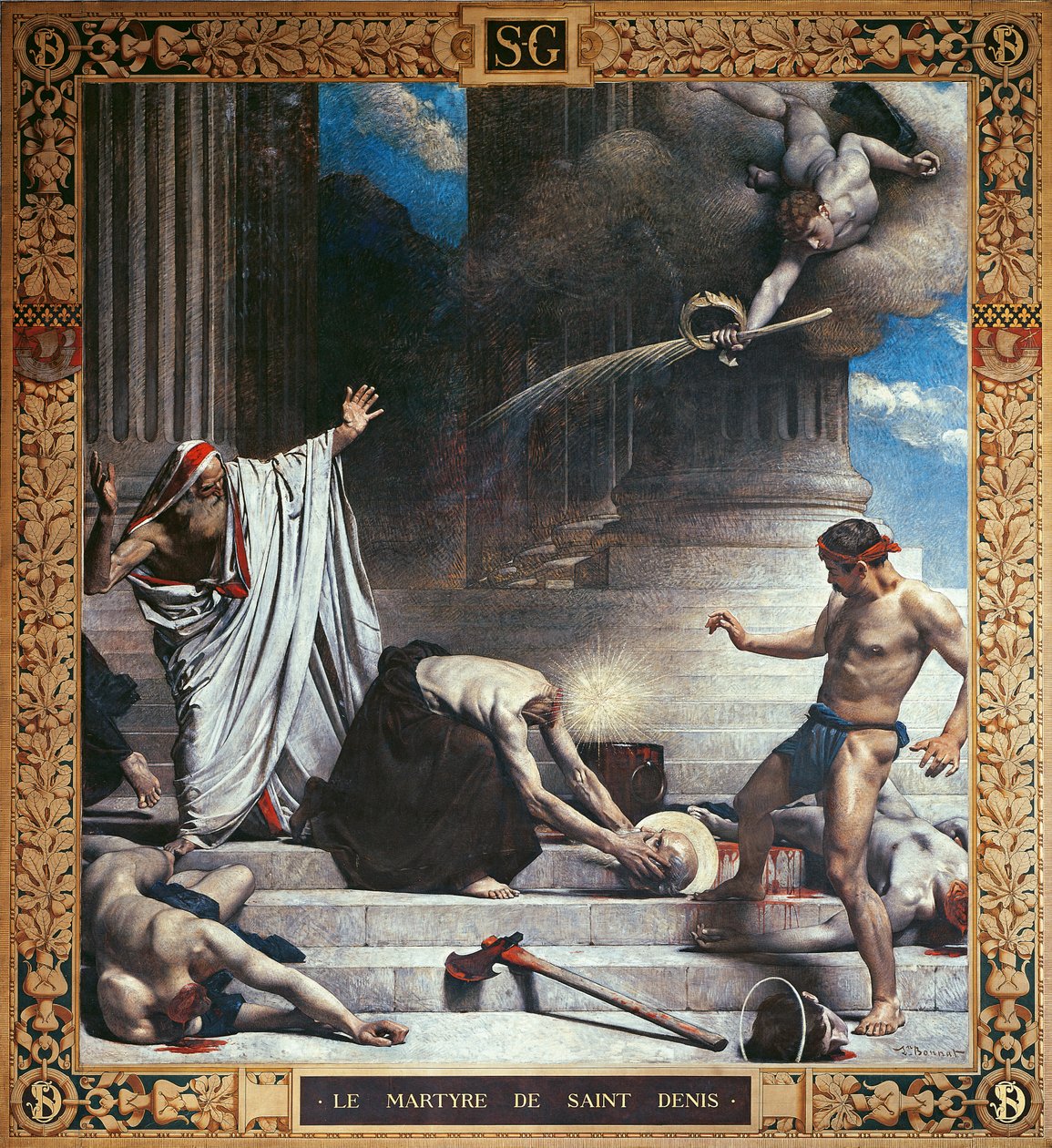
There is an old image worth keeping in mind here. Saint Denis, after his martyrdom, is said to have picked up his own severed head and continued walking — preaching, it is said, on the way. Every person who looks at a smartphone is doing something close to that. We have externalised our memory into databases. We have externalised our imagination into screens. We have externalised our reasoning into algorithms. We are walking around holding our own heads in our hands, having a perfectly coherent conversation with the rest of our body.
The temptation is to read this as a horror story — a story about emptying. But it is also the opposite story. For most of human history, the biological brain was forced to act as a storage locker and a brute-force calculator, because nothing else could do that work. With those jobs increasingly offloaded, the brain is released from the work it was always worst at, and freed to do the work it was always best at: synthesis, judgement, empathy, invention, the recognition of pattern across domains.
The role left for the human in this configuration is not the one Romantic culture trained us to value. We are not, in this picture, the source of the work. We are the orchestrator of it. That sounds like a demotion. It is not. The conductor plays none of the instruments, and yet the difference between a symphony and a row of competent musicians is the conductor's judgement — knowing what is supposed to happen, hearing when it isn't, and stepping in at the precise moment that makes the difference.
We are walking around holding our own heads in our hands, having a perfectly coherent conversation with the rest of our body.
We have always been carrying parts of ourselves outside ourselves. The novelty of this moment is the speed at which the next layer is being installed, and the part of us being installed. For the first time, what we are holding in our hands is not the trace of our past but the gesture of our future — the anticipating itself. The only genuinely new questions worth asking are whose clock it runs on, and what the freed head is finally for.
Where this leads — This essay is the philosophical floor beneath the rest of Viquo’s writing on intelligence. Its closing argument — that we are no longer the source of the work but the orchestrator of it — is carried into markets in The Return of Judgement (2026). The operating system that installs this new time-coordination layer across cognitive labour is Viquo: An Agentic Operating System (2026); and the macro dislocation it sits within is The Great Dislocation (2025).
Viquo Insights presents the editorial views of the author and the firm’s ongoing, exploratory thinking. It is provided for information and discussion only, and is not investment advice, nor an offer or solicitation to buy or sell any security or to adopt any investment strategy. You should do your own research, and we would always be very happy to know what you think, what you find, and how we can learn together.